Jeshua Nunez
Dr. Clenance
English 110 B
11/5/25
Dear Dr. Clenance,
In this cover letter, I want to explain the thinking behind my synthesis essay and why I chose to focus on non-native English students in elementary schools. As someone who grew up bilingual, this topic stood out to me because I was raised with a lot of multilingual students who deal with systems that don’t understand or support them. This is still a recurrence that raises my attention for this assignment. Due to all of that, I want my audience to be generally anyone interested in the education system or who shares a similar background from me. Since this is my first synthesis, I wanted to aims for concern and realization how, yes grading systems and education itself is modernized to be equal and fair for any student, there’s still minor flaws that puts certain students at a disadvantage. This theme is funneled into English for Elementary students (K-5) but could also be considered for grades higher up. My journey throughout this assignment was very frustrating and a mix of emotions. I had to constantly change and tweak my essay’s claims and word choices to avoid generalization or anything else. However, I am consent with my progress and glad I finalized into making a well-tuned synthesis around education for English learning students. While researching, I learned how grading systems that are supposed to be “fair” actually end up misjudging EL students, especially when the tasks depend too much on Standard English and a grade involved with it. I also found studies showing how teachers’ expectations and judgments can be influenced by a student’s EL label, even when their work is on the same level. These ideas shaped my first paragraph and helped me build my main argument. Overall, writing this essay helped me see the bigger picture behind the struggles multilingual students face, not because of ability but because of systems and teaching practices that don’t fit them. I hope this provides some background into why I chose these sources and how my essay developed. Thank you for reading my work. Have a great day.
Sincerely,
Jeshua Nunez
Lost In Translation
Non-native English speakers in elementary classrooms often face challenges that go beyond their individual abilities, stemming from systemic inequality in grading, teaching, and instructional beliefs. Research shows that grading systems, though intended to be fair, often misrepresent EL students’ knowledge because assessments depend heavily on English proficiency (Committee on Fostering School Success for English Learners, Pg. 421). Additionally, teachers sometimes unconsciously judge ELs based on language status rather than content mastery, leading to lower academic expectations and inaccurate evaluations (Umansky & Dumont). These inequities are significant when educators lack proper ESL training, which reduces their confidence and ability to address EL students’ needs effectively (Tran,
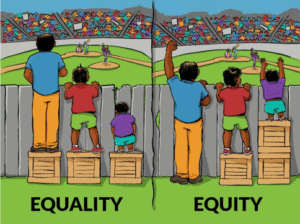
Shreve). Instructional approaches also matter, asset-based methods, which build on students’ existing strengths, enhance engagement and achievement, while deficit-based approaches can harm self-esteem and impede learning (Yasir, Akram). Together, these findings highlight those inequities for EL students, emphasizing the need for reforms in grading practices, teacher preparation, and teaching beliefs.
Non-native English speakers in elementary classrooms often struggle not because they lack ability, but because modern grading systems unintentionally work against them. Systems like standards-based grading, rubric-centered evaluation, and performance tasks are designed to promote fairness, yet research shows they regularly misrepresent English Learners’ (ELs’) actual academic abilities. The Committee on Fostering School Success for English Learners emphasizes this problem in “Promoting the Educational Success of Children and Youth Learning English: Promising Futures”, noting that “Every assessment is in part a language assessment” (Committee, pg. 421). They further note that assessments “valid and reliable for one purpose may be invalid or unreliable for other purposes” (Committee, pg. 421), meaning that if a task depends heavily on English proficiency, it cannot accurately measure EL students’ content knowledge. This challenge deepens when teacher judgments influence grading practices Recent research by Ilana Umansky and Hanna Dumont strengthens this concern by demonstrating that teachers often judge ELs based on language status rather than academic performance. Their study “Do teachers have biased academic perceptions of their English learner students?” found that “EL classification resulted in teachers having lower academic expectations of their students,” and that teachers “rated EL students significantly lower… even when both groups had similar test scores” (Umansky & Dumont). These findings are especially powerful because they show that grading is not just influenced by language demands, but also by educators’ unconscious biases. All in all, this evidence demonstrates that even well-intentioned grading systems become unreliable for ELs when they rest on subjective interpretations of student work and language-heavy assessments.

Building on the issue of biased and unreliable grading practices, another factor that deepens inequity for non-native English speakers is the widespread lack of suitably trained teachers in elementary classrooms. Even if grading systems were redesigned to be more fair/equal, EL students would still be disadvantaged if the educators evaluating them lack the skills necessary to support language development. Yune Tran’s peer-reviewed study “ESL Pedagogy and Certification: Teacher Perceptions and Efficacy” directly addresses this problem, showing that “findings revealed a statistical significance in efficacy beliefs for teachers with an ESL certification as opposed to teachers without the credentials” (Tran, pg. 2). This matters because teacher efficacy, meaning how confident and prepared educators feel, strongly influences instructional quality and the accuracy of the judgments they make about students’ work. Without ESL training, teachers often struggle to distinguish between language errors and actual misunderstandings of content, leading to incorrect grading decisions. Jenn Shreve who publishes articles towards professional learning and technology development, reinforces this in her article: “Educators Are Poorly Prepared for ELL Instruction,” where teachers reported “frustration over not being able to communicate with students and parents, lack of appropriate materials, and a lack of accurate information about exactly what academic content their students already know and what they need to learn” (Shreve). These frustrations translate into instructional gaps that directly affect how students’ learning is assessed. Together, Tran and Shreve show outcomes for ELs stem not only from grading systems themselves but also from the limited preparation of the teachers applying those systems. Improving ESL-focused training and professional development is therefore essential if schools want grading and instruction to reflect what students actually know and can achieve.

A common controversial topic in educational practice is the debate between asset-based and deficit-based approaches. Both claims to support student learning, yet they differ sharply in how they view and respond to students’ needs. Asset-based teaching focuses on developing the skills and strengths students already possess, working with what is present. In contrast, deficit-based teaching centers on what students lack, often framing their language or cultural background as problems to be fixed. Because these approaches operate from fundamentally different perspectives, many educators and researchers argue that deficit-based models should be phased out in favor of more supportive, asset-based practices. Husum Yasir and Waseem Khan Akram, authors of the research article “Leveraging Strengths vs. Addressing Weaknesses: The Impact of Asset-Based and Deficit-Based ESL Approaches on Elementary Students,” directly compare these models in the context of ESL instruction. They note that deficit-based approaches can harm ESL students by treating their native languages and cultures as barriers, whereas asset-based instruction recognizes them as meaningful resources that enhance learning (Yasir & Akram, pg. 4). This shift in perspective leads to more effective language development and stronger student engagement. Yasir and Akram further highlight the consequences of relying on deficit thinking, explaining that “deficit-based models, which emphasize students’ weaknesses, often lead to reduced self-esteem, disengagement, and lower academic performance. In asset-based classrooms, the emphasis on collaborative learning also plays a role in boosting academic achievement” (Yasir & Akram, pg. 7). Together, their findings emphasize the urgency of expanding asset-based instruction and minimizing deficit-based practices. Prioritizing asset-based learning is not preferable but it is necessary for supporting the growth, confidence, and academic benefit of non-native English students.
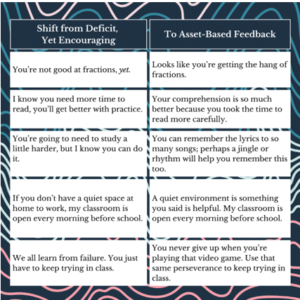
In conclusion, inequality for non-native English speakers in elementary classrooms arise from multiple, related factors. Grading systems often fail to accurately measure ELs’ abilities, teachers without proper ESL training struggle to support their students effectively, and deficit-based instructional approaches can hinder learning and self-confidence. Research consistently shows that addressing these issues through equitable assessment practices, improved teacher preparation, and asset-based teaching can create a more inclusive and effective learning environment. By implementing these changes, schools can better ensure that all students, regardless of language background, have the opportunity to grow academically and develop.
Works Cited
Committee on Fostering School Success for English Learners: Toward New Directions in Policy, Practice, and Research. “Promoting the Educational Success of Children and Youth Learning English: Promising Futures (2017).” Nationalacademies.Org, www.nationalacademies.org/read/24677/chapter/13
Shreve, Jenn. “Educators Are Poorly Prepared for ELL Instruction.” Edutopia, George Lucas Educational Foundation, 24 Oct. 2005, www.edutopia.org/no-train-no-gain.
Tran, Yune, “ESL Pedagogy and Certification: Teacher Perceptions and Efficacy” (2015). Faculty Publications – School of Education. Paper 98. http://digitalcommons.georgefox.edu/soe_faculty/98
Umansky, Ilana, and Hanna Dumont. “Do Teachers Have Biased Academic Perceptions of Their English Learner Students?” Brookings, 3 Feb. 2025, www.brookings.edu/articles/do-teachers-have-biased-academic-perceptions-of-their-english-learner-students/.
Yasir, Husum, and Waseem Khan Akram. “(PDF) Leveraging Strengths vs. Addressing Weaknesses: The Impact of Asset-Based and Deficit-Based ESL Approaches on Elementary Students’ Learning Outcomes and Classroom Participation.” Leveraging Strengths vs. Addressing Weaknesses: The Impact of Asset-Based and Deficit-Based ESL Approaches on Elementary Students’ Learning Outcomes And, www.researchgate.net/publication/383943228_Leveraging_Strengths_vs_Addressing_Weaknesses_The_Impact_of_Asset-Based_and_Deficit-Based_ESL_Approaches_on_Elementary_Students’_Learning_Outcomes_and_Classroom_Participation.

This entry is licensed under a Creative Commons Attribution-NonCommercial-ShareAlike 4.0 International license.

